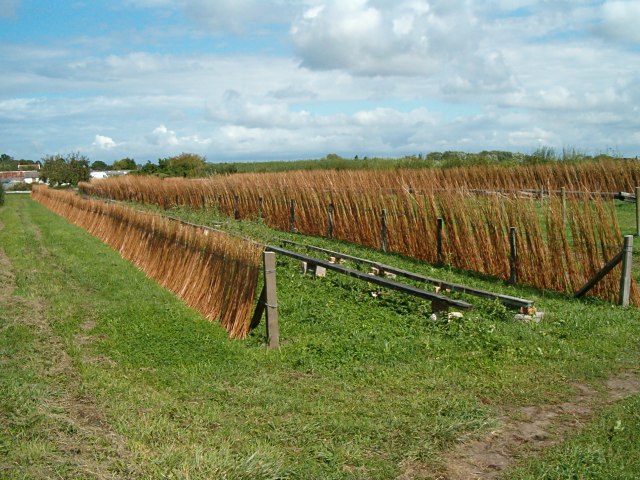
What is Osier?
Osier is a term used for willow varieties grown specifically for their long, slender, flexible rods, rather than for timber or ornament. The most commonly cultivated species for basket making is Salix viminalis (common osier), though several other Salix species — including Salix purpurea (purple willow) and Salix triandra (almond willow) — produce rods used in traditional and contemporary basketwork.
The word "osier" derives from Old French, reflecting a time when cultivated willow beds (osier beds) were a standard part of agricultural land management in Western and Central Europe. In Polish, the equivalent term is wiklina, which refers both to the plant and to the craft tradition using it.
Harvesting: Timing and Method
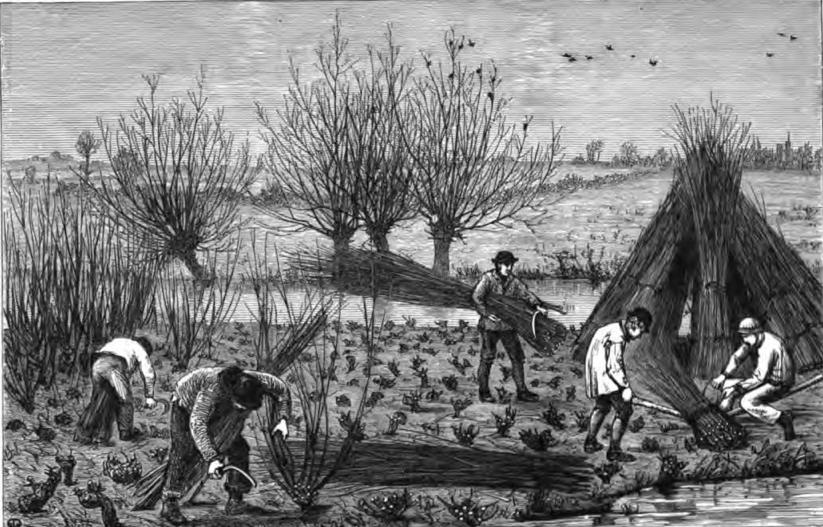
Osier rods are typically harvested once per year, during the dormant season — from late autumn through early spring, depending on local climate. Harvesting during dormancy, when the sap has retreated to the roots, produces rods with less active inner moisture, which affects how the bark behaves during drying and peeling.
The cut is made close to the base of the stool (the established root crown that re-sprouts each year). A sharp billhook or secateurs produces a clean cut that does not leave a jagged stub prone to disease. Rods are bundled loosely in the field — tightly bound bundles trap moisture and encourage mould during transport.
Rod length at harvest typically ranges from 60 cm to over 3 metres, depending on the species, the stool's age, and the season's growing conditions. Sorting by length before drying allows more efficient storage and simplifies selection during weaving.
Brown Rod: Drying Without Peeling
Brown rod is the simplest preparation: rods are dried with the bark intact. After harvest, they are stood upright in loose bundles — pointed end down — in a sheltered, well-ventilated location away from direct rain. Standing upright allows moisture to drain downward and gravity to keep the rods straight as they dry.
Drying time varies by rod thickness, species, and ambient conditions. Thin rods (under 8 mm diameter) in dry conditions may be fully seasoned in six to eight weeks. Thick rods from older stools can take several months. A properly dried brown rod will produce a hollow sound when tapped and will not feel cool against the skin — signs that residual moisture has been lost.
Before weaving, brown rod must be soaked and mellowed. Soaking — typically submerging bundles in a water tank or stream for one to several days — rehydrates the bark and inner wood sufficiently for bending without cracking. After soaking, the rods are wrapped in damp cloth or sacking and left for several hours (mellowing) to allow moisture to distribute evenly through the diameter.
White Rod: Peeling When Fresh
White rod is produced by peeling freshly harvested or newly risen (sap-active) rods. The window for easy fresh peeling is narrow — it corresponds to the period when sap is actively moving through the cambium layer, loosening the bark from the wood beneath. This period is typically late spring to early summer for most Salix species in Central European conditions.
The traditional peeling tool is a cleave or brake — a forked implement held steady while the rod is drawn through. A well-sharpened brake set to the correct gap removes bark cleanly without gouging the wood. Peeled rods are then dried in the same fashion as brown rod: stood upright, out of direct rain and sun.
White rod has a lighter, smoother appearance than buff rod, but the surface can develop grey streaks if drying is uneven or if the rod is left exposed to ultraviolet light. Covering drying racks with breathable fabric reduces discolouration.
Sorting and Grading
Sorted rod bundles — graded by length and approximate diameter — are the professional standard. Grading by length is straightforward (a length gauge, typically a marked board, is used). Grading by diameter (the butt, or thicker end, is measured) allows a weaver to select consistent material for specific parts of a basket where uniform thickness matters, such as borders and handles.
Buff Rod: Boiling After Drying
Buff rod is made from dried brown rod that has been boiled — submerged in a tank of heated water for several hours. The heat and moisture loosen the bark just as sap movement does in spring, allowing peeling of dried rod outside the narrow fresh-peeling window. The resulting surface colour is darker than white rod: a warm tan or amber tone caused by tannins released from the bark during boiling.
The boiling tank (historically a long, shallow iron tank heated from below by a firebox) is a significant infrastructure commitment. In industrial osier growing areas — such as the Somerset Levels in England, or parts of the Vistula floodplain in Poland — communal boiling tanks were shared among multiple growers. The boiling process typically runs for four to six hours, after which rods are spread to cool before peeling.
Storage of Prepared Rod
Fully dried, unsoaked rod can be stored for extended periods — multiple years if conditions are correct. The key requirements are low humidity, good air circulation, and absence of direct light. Bundles stored in damp outbuildings develop mould that stains the bark and weakens the wood fibre. Vermin damage is also a concern; mice and rats will chew stored rod.
In practice, most basket weavers maintain a stock sufficient for six months to a year of anticipated work, sourcing new material annually from cultivated osier beds or from specialist suppliers. In Poland, commercial osier growing is documented in the Vistula valley counties, particularly around the Żuławy delta area, where river-deposited soils and historically high water tables supported large-scale cultivation.
Osier beds require regular coppicing — cutting back to the stool — to maintain productive rod growth. A stool can remain productive for many decades if managed consistently. Neglected stools revert to tree form and eventually produce thicker, less flexible growth unsuitable for basketry.
Material Selection for Specific Basket Types
Different basket types call for different rod characteristics. Heavy agricultural baskets (grain measures, potato harvesters, log carriers) benefit from thick brown rod — the unpeeled bark adds slight additional rigidity and the surface is more resistant to rough handling. Fine work such as market baskets, bread baskets, and cradles is typically done in white or buff rod, where the smooth, pale surface is both aesthetically appropriate and hygienically easier to maintain.
Stake-and-strand construction — the most common form in Polish willow basket making — uses thicker, stiffer rods as stakes (the vertical or radiating structural elements) and thinner, more flexible rods as weavers (the elements that interlace over and under the stakes). Matching rod types correctly to these different roles is part of the foundational knowledge of the craft.
References
Technical detail on Salix cultivation and rod preparation is documented in the UNESCO ICH records for European basketry traditions. For botanical context on osier species, see entries in the Global Biodiversity Information Facility (GBIF) database, which holds distribution records for Salix viminalis and allied species across Poland.